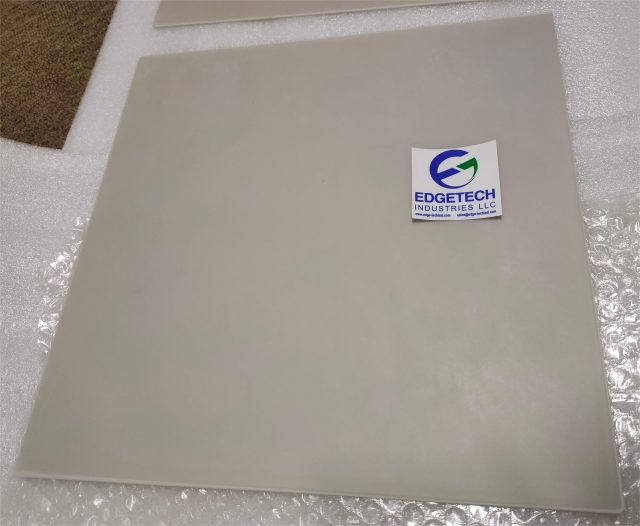
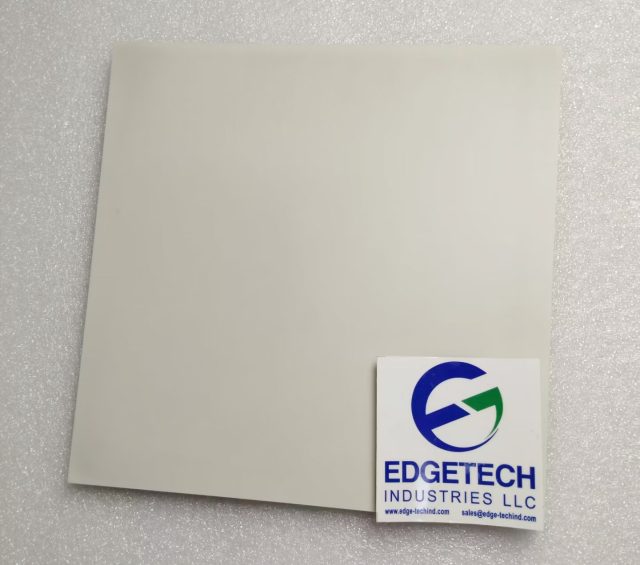
Aluminum Nitride Substrates


Edgetech Industries, Advanced Ceramics Division supplies high-quality and competitive price advanced Aluminum Nitride Substrates.
Custom AlN Ceramic Substrates for Thermal Management
Edgetech supplies aluminum nitride substrates for power electronics, semiconductor packaging, laser systems, RF and microwave equipment, and other applications requiring electrical insulation together with efficient heat transfer.

Custom aluminum nitride substrate
Aluminum nitride is often selected when alumina cannot provide sufficient thermal performance but electrical isolation is still required. The finished performance of an AlN substrate, however, depends on more than thermal conductivity. Material grade, thickness, flatness, surface finish, dimensional tolerance, edge quality, and assembly conditions all influence the thermal and mechanical behavior of the final component.
Edgetech Industries provides bare and custom-machined AlN ceramic substrates according to customer drawings. Material grade, dimensions, tolerances, surface condition, and inspection requirements should be defined before quotation.
| Aluminum Nitride Substrate Typical Product Information | |
| Property | Available Range or Requirement |
| Material | Aluminum Nitride Ceramic |
| Thermal conductivity | 170W/mk, 200W/mk, 230W/mk |
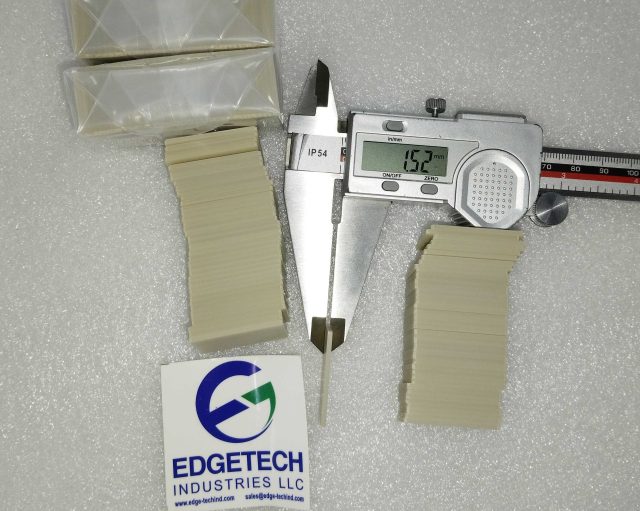
| Standard thicknesses | 0.38mm, 0.5mm, 0.635mm, 1mm, 1.2mm, 1.5mm |
| Custome thicknesses | 0.25mm~2mm |
| Maximum length and width | 300mm x 300mm |
| Length and width tolerance | +/-0.2mm |
| Thickness tolerance | +/-0.05mm |
| Warpage | 3‰ |
| Surface roughness | Ra 0.05-0.8um |
| Surface condition | As-fired, lapped, polished |
| Holes and slots | Available according to drawing |
| Edge condition | Square, chamfered, or radiused |
| Metallization | Drawings, Gerber files, etc., need to be provided for evaluation. |
| Inspection reports | COA, dimensional inspection report, etc. available |
Why Choose Aluminum Nitride Substrates?
Aluminum nitride (AlN) is a superior ceramic material offering:
✔ Exceptional Thermal Conductivity – Efficient heat dissipation for high-power applications
✔ Excellent Electrical Insulation – Ensures reliable performance in high-voltage environments
✔ Low Dielectric Constant & Loss – Ideal for high-frequency and RF applications
✔ Silicon-Matched CTE – Reduces thermal stress in semiconductor packaging
✔ Non-Toxic & Environmentally Safe – Suitable for sensitive applications
AlN is commonly considered when the application must remove heat from an electronic device without creating an electrically conductive path.
The highest published conductivity is not always the best purchasing specification. The selected material grade must also meet dimensional, surface, mechanical, electrical, and cost requirements.
Properties of Aluminum Nitride Ceramic
| Item | Unit | AlN |
| Physical Property | ||
| Color | \ | Grayish white, Beige |
| Volume Density | g/cm3 | 3.3 |
| Surface roughness | um | 0.2-0.85 |
| Warpage | (length ‰) | ≤3 |
| Thermal properties | ||
| Thermal conductivity | W/m.k | 170-230 |
| Thermal expansivity | x 10-6/°C (20℃-800℃) | 4-6 |
| Mechanical properties | ||
| Flexural strength | MPa | ≥300 |
| Electrical properties | ||
| Dielectric constant | 1MHZ, 25℃ | 8-9 |
| Dielectric strength | KV/mm | ≥15 |
| Volume resistivity | Ω.cm | ≥1014 |
Bare and Custom-Machined AlN Substrates
This product page primarily covers bare and custom-machined aluminum nitride ceramic substrates.
ETI Ceramics can evaluate substrates with:

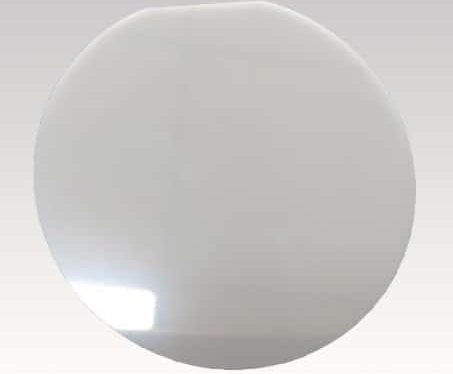
Bare AlN ceramic substrate
- Rectangular or square profiles
- Circular profiles
- Custom outlines
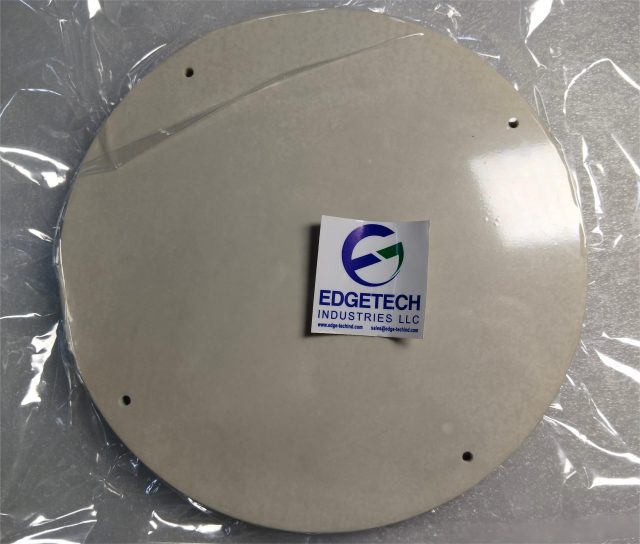
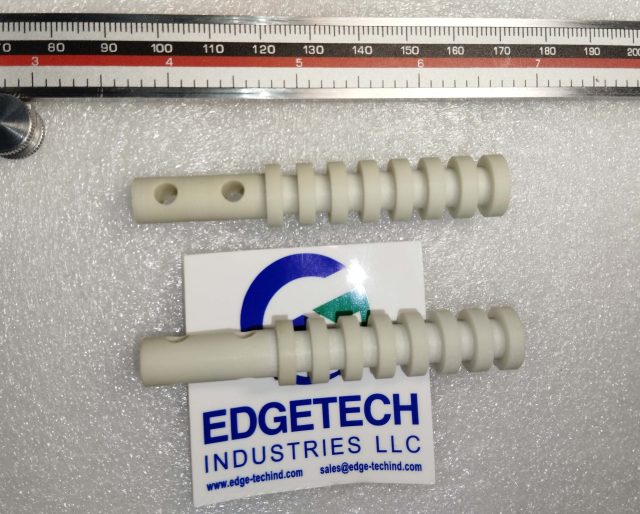
- Through-holes
- Slots
- Notches
- Edge chamfers
- Corner radii
- Lapped surfaces
- Polished surfaces
- Controlled thickness
- Application-specific flatness
Availability depends on substrate thickness, overall dimensions, tolerance requirements, and order quantity.
Metallization, bonded copper structures, or completed circuit configurations should not be assumed to be included unless they are specifically confirmed in the quotation.
Thickness, Flatness, and Surface Finish
Thickness should be selected according to the thermal path, handling requirements, assembly method, and mechanical load.
A thinner substrate may reduce heat-travel distance, but it can also be more sensitive to handling and mounting stress. A thicker substrate may improve stiffness but increases the conduction distance through the ceramic.
Flatness and surface finish are also important when the substrate contacts:
- Semiconductor die
- Adhesive or solder layers
- Heat spreaders
- Baseplates
- Cold plates
- Precision fixtures
- Printed or deposited circuit layers
The purchase drawing should define the required flatness, measurement area, surface roughness parameter, and inspection condition. Terms such as “very flat” or “smooth surface” should be replaced with measurable values.
Key Applications of Aluminum Nitride Ceramic Substrate
Our AlN substrates are widely used in:
Electronics & Semiconductor Packaging
High-density hybrid circuits
Microwave & RF power devices

 Machined aluminum nitride ceramic plate
Semiconductor power modules
Thin-film circuit substrates
Chip carriers requiring high thermal conductivity
LED & Optoelectronics
High-power LED packaging
Laser diode heat sinks
Optoelectronic component substrates
Industrial & Defense Applications
Power resistor substrates
Dielectric layers in optical storage
Military-grade electronic systems
Reliable Packaging & Quality Assurance
At Edgetech Industries, we ensure every aluminum nitride substrate is meticulously handled and packaged to prevent damage during transit. Our strict quality control guarantees that you receive premium AlN ceramic materials in perfect condition.
Partner with a Leading Aluminum Nitride Ceramic Supplier
For high-performance aluminum nitride ceramic substrates that enhance thermal management and device reliability, trust Edgetech Industries. Contact us today to discuss your project requirements!

AlN substrate for power electronics
FAQ Content
What thermal conductivity is available for aluminum nitride substrates?
Thermal conductivity depends on the specific AlN grade and test condition. ETI Ceramics should list only verified values for the exact grades offered. The highest conductivity value should not be applied to every substrate.
Is aluminum nitride better than alumina?
Aluminum nitride generally provides better thermal conductivity, while alumina may offer a lower-cost solution for applications with moderate heat loads. The correct choice depends on thermal performance, electrical requirements, dimensions, mechanical conditions, and budget.
Can aluminum nitride substrates be supplied with custom holes and profiles?
Custom holes, slots, notches, and outside profiles can be evaluated according to substrate thickness, feature size, tolerance, and quantity.
Does ETI Ceramics supply metallized AlN substrates?
This page primarily covers bare and custom-machined aluminum nitride ceramic substrates. Metallized configurations must be confirmed separately according to technical, production, and export requirements.
Why are flatness and surface finish important?
Flatness and surface finish can affect die attachment, interface thickness, contact area, assembly stress, and overall thermal resistance. They should be specified according to the next manufacturing or assembly process.
Related Products